Practice Cards or a Worked Example? Choosing Materials for Skill Practice
Practice cards or a worked example? Choose materials that help learners start a task, repeat it with purpose, and know what a sound result looks like.
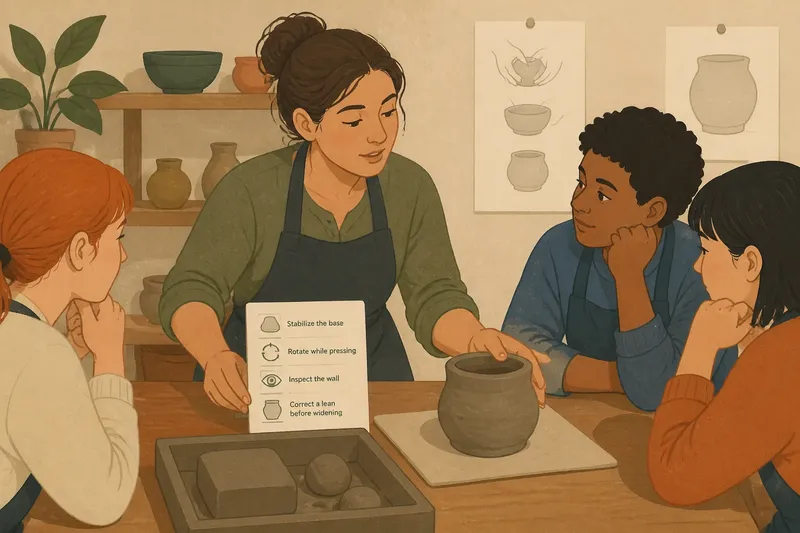
Mara sets a practice card beside a tray of clay, then puts a finished pinch pot on the table. Her learners look from one to the other and wait. The card says what to try; the pot shows what the whole attempt can become. For practical skill instruction, the choice between practice cards and a worked example is not a contest between tidy paper and attractive objects. It is a decision about what learners need to see or do next.
Imagine Mara is teaching a small group to make a pinch pot. This is an invented situation, not a report of a real class. She wants each learner to form a stable base, raise the walls evenly, and leave an opening that does not collapse. At the outset, she has a prompt card listing those actions and a completed pot. The problem is not a lack of materials; it is deciding which one should carry the main burden during practice.
What does each material ask the learner to do?
A practice card is a compact prompt for action. It might name a sequence, pose a check, or remind the learner of a decision: “Rotate the clay as you press,” “Check the wall from the side,” or “If one side is low, work there before widening the opening.” Its value lies in directing attention while the learner performs the skill.
A worked example presents a completed model or a clearly shown sequence of decisions. It can reveal the shape, order, and relationship among parts that are hard to capture in a short phrase. For Mara’s class, a finished pot makes the intended form visible; a set of process images could show how the base and walls change during forming.
The distinction resembles a recipe card beside a plated dish. The card can prompt the next action, while the dish lets a cook compare the result. Neither tells the whole story on its own. A good material answers the question that is currently blocking practice.
What happens when Mara starts with the model?
Mara first places the finished pot where everyone can inspect it. She points out its broad base, gently rising sides, and uneven hand-built surface. She does not present it as the only acceptable pot; it is one readable example of the qualities the task calls for.
For learners who have not formed clay before, the model gives a concrete destination. “Make the walls even” can sound like an abstract instruction until a learner can compare a wall that leans with one that rises steadily. The pot also helps Mara name visible features without relying on a long explanation.
Then the limitations appear. A finished pot cannot show how much pressure formed the base, which part Mara worked first, or what she did when the rim began to distort. Learners may imitate the silhouette while missing the actions that produced it. A polished model can also seem like a standard they are expected to match exactly, which is unhelpful if the learning goal is controlled hand pressure rather than identical objects.
Mara adjusts the use of the example. She asks learners to identify two features they can see and one thing they cannot infer from the finished object. The question turns the model from a silent answer into a reference with boundaries. It also gives her a reason to make the process visible before learners work independently.
When does the card become more useful?
After learners have seen the form and understood the broad sequence, Mara introduces the prompt card. Its short cues are arranged around the decisions learners make while handling the clay: stabilize the base, rotate while pressing, pause to inspect the wall, and correct a lean before enlarging the opening. The card does not repeat every explanation. It keeps a few useful checks within reach.
That shift matters because practice involves repeated attempts. A learner may remember the general goal but forget to rotate the clay, or may keep pressing an area that is already thin. A prompt can bring attention back to the relevant action without requiring Mara to repeat the same reminder at every table.
Cards are especially useful when the skill has a small set of recurring checks, when learners can act on a short cue, or when the teacher wants learners to become less dependent on spoken reminders. They are less useful if each learner needs a different decision that cannot be captured in a brief prompt, or if unfamiliar terms make the card another puzzle to solve.
Mara notices that “even walls” is too vague for some learners. She revises the cue to ask them to turn the pot and look at its side before choosing where to press. The revised wording points to an observable check and leaves the adjustment to the learner. A card should guide attention, not pretend that every hand and every piece of clay will need the same correction.
How should the two materials work together?
Mara now uses the pot to establish what a sound result can look like and the card to support repeated attempts. Learners study the example, make a first pot, consult the card at chosen pauses, and compare their work with the visible features that matter. The model supplies a reference; the card supplies a prompt for action.
Suppose one learner makes a pot whose opening is broad but whose base is thin. Mara can point back to the model’s stable lower shape, then ask the learner to use the card’s side-view check on the next attempt. The learner has a visible feature to consider and a concrete action to try. The expected observable result is that the learner can inspect the base deliberately and make a more considered adjustment, not that every pot will match the model.
The pairing needs restraint. If the card contains a full explanation and the model has been annotated with every possible correction, learners may spend more effort decoding materials than practicing. Mara keeps the example focused on the intended qualities and the card focused on a few decisions that recur during work.
How can you choose between them?
Start with the learner’s immediate obstacle rather than the format you already have. If a learner cannot picture the intended result or understand how parts relate, a worked example may help. If the learner understands the task but loses track of checks during repetition, a prompt card may be the more useful support.
- Choose a worked example when the desired form, sequence, or relationship among parts is difficult to imagine from words alone.
- Choose a prompt card when learners need brief reminders while carrying out a task they have already been introduced to.
- Use both when learners need a visible reference for quality and a small set of cues to guide repeated attempts.
- Revise the material if learners keep asking what a term means, cannot connect a cue to an action, or copy a model without noticing its relevant features.
- Reduce support when learners begin checking their work and choosing adjustments without consulting the prompt at every moment.
These choices are not permanent labels for a skill. A learner may need the example at the beginning of a session and the card during later practice. Another learner may understand the example quickly but still benefit from a prompt that directs attention to a neglected check.
What questions should shape the final choice?
Can a worked example teach a movement by itself?
A finished object can show qualities of the result, but it cannot reveal every movement used to make it. If the movement matters, pair the object with a visible account of the process or a brief, focused explanation.
Should a practice card contain the whole procedure?
Usually, a card works better as a reminder than as a replacement for instruction. Keep its cues short enough to use during action, and provide fuller explanation separately when learners need it.
How do you know a prompt is too vague?
If learners cannot tell what to look at or do after reading it, the cue is probably too broad. Replace general advice such as “be careful” with a check they can observe and an action they can choose.
When should learners stop relying on the card?
Reduce prompts when learners can recall the relevant checks and use them to guide their own decisions. Keep the card available as a reference if occasional consultation helps without interrupting the work.
What does Mara change for the next session?
By the end of the invented session, Mara sees that the pot and the card answer different questions. The pot answers, “What features are we aiming to notice?” The card answers, “What should I check as I work?” Her next version keeps the model visible, makes the card’s cues more observable, and leaves room for learners to make different corrections.
For a practical skill, choose practice cards or a worked example according to the point where the learner gets stuck: imagining a result, deciding what to do, or remembering what to inspect while doing it. The distinction is small but useful. Materials become more effective when each one has a clear job, and learners can spend their attention on the skill rather than guessing what the paper is for.