The Feedback Sandwich Is Not a Recipe
The feedback sandwich can bury useful instruction. Replace scripted praise and criticism with a specific observation and a clear cue for the next attempt.
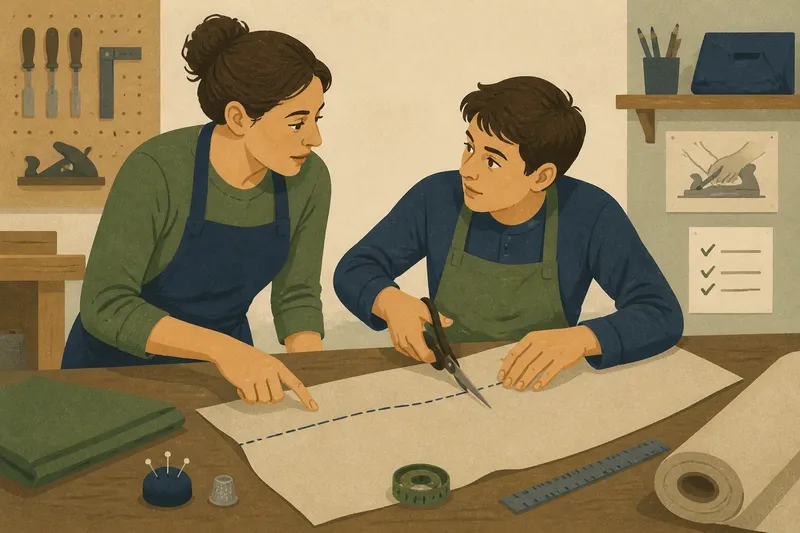
A learner trims a piece of fabric, looks up, and hears, “Great focus. The edge wandered. But you’re doing really well.” The feedback sandwich has arrived; the learner may leave knowing they were praised, corrected, and praised again, but not what to do with the scissors.
For practical skill instruction, the feedback sandwich is not a recipe. A fixed praise-criticism-praise sequence can soften a correction until its useful point disappears. A more helpful exchange connects one visible observation to one action the learner can try next.
What does the learner need to hear?
Feedback is most useful when it points to a feature of the work the learner can recognize. “The edge wandered” names a result, but not necessarily its cause or a way forward. “The fabric shifted as you cut” identifies a visible event that can guide another attempt.
That distinction matters in skills such as sanding, kneading, drawing, or fitting a joint. Broad judgments like “careful,” “sloppy,” or “natural” describe the person’s performance from the instructor’s point of view. Specific observations give the learner something to compare with the material in front of them.
Keep the observation narrow. If a learner is practicing a wood chisel, there may be several things to discuss: grip, blade angle, pressure, and where the cut ends. Calling out all four at once turns useful feedback into a small inventory of unfinished business.
Why does the sandwich blur the point?
The trouble is not praise itself. Accurate encouragement can tell a learner what is already working and worth keeping. The trouble is treating praise as required packaging for every correction, whether or not it clarifies the task.
In a fixed sequence, the correction sits between two positive remarks. A learner may hear the opening praise as a signal that nothing much needs changing, or wait through the closing compliment for the actual instruction to arrive. The wording is kind; the signal is mixed.
Generic praise can also distract from the evidence. “You’re talented” gives little guidance about a particular cut, stitch, or stroke. “You kept the blade square through the turn” identifies an action the learner can try to repeat. Praise works best when it is as concrete as the correction beside it.
Think of feedback like a pencil mark on a drawing, not a ribbon tied around it. The mark should show where attention belongs; decoration is optional.
How can one observation lead to a better next attempt?
Use a compact sequence: describe what happened, name the feature that matters, and offer a cue for another try. The cue should be something the learner can attempt, not a verdict disguised as advice.
- Describe: “The first stitch pulled the fabric into a small pucker.”
- Focus: “The thread tightened before the stitch was settled.”
- Next cue: “On the next stitch, ease the thread until the fabric lies flat.”
Say you are teaching someone to spread mortar on a practice board. The learner leaves ridges because the trowel lifts at the end of each pass. You might say, “The ridges appear where the trowel lifts; keep the blade in contact through the end of the next pass.” The learner can try that cue and inspect whether the ridges change, without having to decode a judgment about being “more consistent.”
One cue is not a promise that the next attempt will be perfect. It is a useful way to make the next attempt informative. If the result changes, the learner has something to notice; if it does not, the instructor has clearer evidence for choosing another cue.
When should you say less?
In hands-on teaching, feedback competes with the learner’s attention to tools, materials, and movement. A long explanation delivered while someone is holding a hot pan or balancing a workpiece may be poorly timed. Pause the task when needed, then give the observation once the learner can attend to it.
For a low-risk practice task, a brief pause can let the learner notice a result before the instructor names it. Ask, “Where did the line begin to curve?” or “What changed when you eased the pressure?” If the learner cannot identify it, point to the feature and offer a single next cue.
Do not turn every attempt into a running commentary. Learners need room to perform, notice, and make decisions. Choose a moment when the information can still affect the next try, rather than attaching a full review to every movement.
What questions help make feedback usable?
Should every correction begin with praise?
No. Begin with what the learner needs to notice. If something is working, name the specific action and why it matters; if not, state the observation and offer a workable cue without a ceremonial compliment.
How many points should one comment cover?
Usually, focus on one feature that matters to the current attempt. Several corrections can compete for attention, especially when the learner is still coordinating basic movements.
What if the learner disagrees with the observation?
Return to the work rather than arguing about the label. Point to the cut, seam, or surface and ask what each of you can see, then agree on one feature to watch during another attempt.
Can positive feedback still be useful?
Yes, when it identifies a repeatable choice. “You slowed down before the corner, and the line stayed steady” gives more practical information than praise that could fit any task.
How can you tell whether the feedback helped?
Watch what happens on the next attempt, not whether the learner smiles at the comment. Look for the named feature: does the fabric stay flat, does the blade remain in contact, or does the line hold its direction? These are observations, not grades.
If the feature changes, the learner can decide what to keep. If it does not, reconsider the cue, the timing, or whether the task is ready for that level of adjustment. Feedback should respond to the work in front of you, not force the learner through a script.
The useful point is small on purpose: one observation, tied to one next attempt. In practical instruction, that is often enough to make the next try less mysterious and the praise, if there is any, more honest.