How Craft Apprenticeship Passed Skills Between Hands
How craft apprenticeship passed skills between hands: learn which parts of observation and shared work can inform clearer, more teachable sessions.
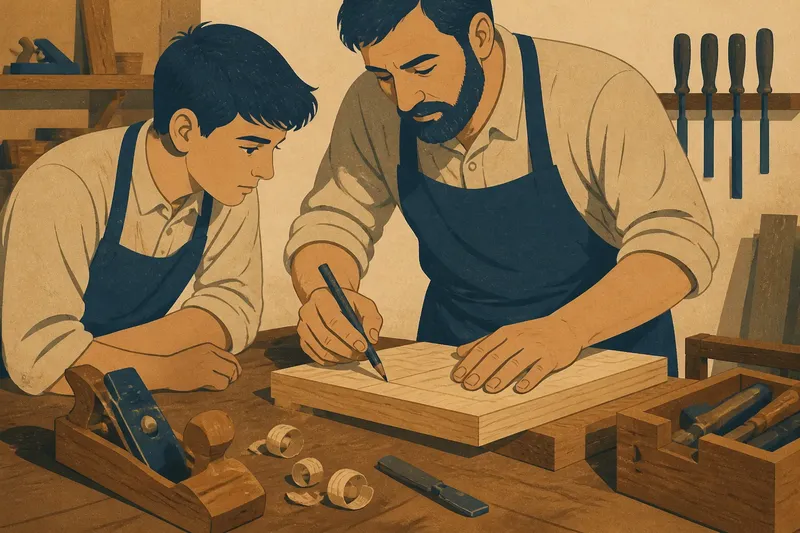
A novice in a joiner’s shop watches an experienced worker mark a board, check its grain, and pause before making a cut. The novice can see the hands and hear the tool, but the useful lesson may be the worker’s attention to the wood. Craft apprenticeship passed skills between hands in many settings, though its practices varied by place, trade, and period.
This is a bounded account of instruction, not a claim that apprenticeship followed one universal pattern. Its value for session design lies in the teaching methods it makes visible: shared tasks, close observation, correction in context, and gradual participation. Those methods existed alongside uneven access and arrangements that could serve the workshop’s needs as much as the learner’s.
How did a learner enter a workshop?
In some crafts and communities, a novice learned through a formal or informal relationship with an experienced practitioner. The learner might join a household or workshop, or gain access to work through another local arrangement. The details depended on the trade and setting; there was no single apprenticeship system common to every craft.
Early duties could include preparing materials, cleaning tools, carrying supplies, or keeping the work area orderly. Such tasks helped a novice become familiar with names, routines, and standards, while also contributing labor. Learning was therefore not always separated from the work the shop needed done.
Access depended on local customs and the people who controlled entry. Family connections, resources, location, and rules about who could take part could shape a learner’s options. A person’s presence near the work did not necessarily mean they could handle important tasks or ask how decisions were made.
For an instructor, this distinction is useful: being in the room is not the same as having access to explanation. A session can make the path from observation to participation explicit, rather than leaving it to custom or chance.
What could observation teach?
A learner could watch not only a movement but also the pause, adjustment, or change of tool that preceded it. A written sequence can name actions, but a demonstration can show the cues that prompt a practitioner to alter that sequence. The learner sees action alongside the conditions that shaped it.
Materials make some consequences visible. Wood may split along its grain, clay may slump, or a seam may pucker. The material’s response gives teacher and learner something specific to inspect together.
Practical skill also involves noticing. A practitioner might listen for a change in sound, feel a surface, or spot an irregularity. Rather than asking learners to memorize a long explanation, an instructor can name one cue, pause, and invite them to locate it in the material.
That is like pointing out the right drawer in a crowded tool cabinet: it helps someone direct their attention, but they still have to learn what is inside and how to use it.
How did shared work move learners toward participation?
In some workshop arrangements, a novice’s responsibilities expanded from preparation to assistance and then to a bounded part of a task. The practitioner could retain responsibility for consequential decisions while the learner took on a real portion of the work. The exact progression depended on the craft, teacher, and available tasks.
Working alongside others could also reveal how one person’s preparation affected the next person’s work. A poorly prepared piece might complicate a later operation. The learner could see that a craft involved connected responsibilities, not merely isolated hand movements.
Imagine a furniture workshop class where a learner is asked to fit a drawer front. The instructor supplies the drawer and front, asks the learner to inspect the opening, and points out a place where the surfaces touch unevenly. The learner marks that contact point before choosing an adjustment; the expected observable result is a mark that identifies the binding area and a stated reason for the next action. The instructor remains responsible for the larger piece and any consequential work.
This kind of bounded participation gives learners a decision to make without treating access as unrestricted. It also gives an instructor a clear place to observe what the learner noticed and why.
Why did correction often belong inside the task?
When a tool slipped or a joint sat poorly, teacher and learner could inspect the result while the material and action were still present. The teacher could refer to a particular choice, such as the angle, sequence, or point of inspection, rather than delivering a general judgment about ability.
Timing matters, but constant interruption can make a learner hesitant. An instructor can let a bounded attempt finish when it is appropriate, then ask the learner to explain the decision and inspect the result together. If an immediate correction is needed to keep the task within safe bounds, the instructor should intervene rather than wait for a teaching moment.
Correction can include repair as well as prevention. A learner benefits from seeing how a practitioner adapts after an error or decides that a piece cannot serve its intended purpose. A polished demonstration that hides every difficulty leaves out part of practical judgment.
A manual and a teacher serve different purposes. Written material can preserve terms, sequences, and reminders for later reference; a teacher can respond to a particular attempt. Neither needs to pretend to do the other’s job.
What did apprenticeship leave unclear?
Knowledge held in memory and custom did not automatically come with an explanation. A learner might copy a movement without learning why it mattered, or encounter a different name or standard with another practitioner. The quality of teaching depended on what the teacher chose and was able to explain.
Opportunities could also be difficult to track. A learner’s access to tasks depended on the relationship, the work available, and the practitioner’s willingness to delegate. Without shared records or stated expectations, a learner might have little clarity about what they had practiced or what competence would look like.
Nor did an inherited method become sound instruction simply because it had been passed on. Local customs could preserve useful judgment, but they could also preserve arbitrary expectations or exclude some learners. Historical practice is worth examining without treating every custom as a model for a present-day class.
A written reference can make terms, sequence, and expectations easier to share. Like a label on a tool drawer, it helps learners find the same item again; it cannot explain how the tool responds in use.
What questions can shape a session?
What should a learner observe before trying the task?
Choose one visible cue that affects a decision, such as grain direction or surface alignment. Name it, demonstrate where to look, and give learners time to find it on the material before they begin.
Which part of the task can a learner take responsibility for?
Separate preparation, bounded decisions, and consequential work. Assign a meaningful portion the learner can attempt while the instructor retains responsibility for work that requires additional experience or supervision.
How can a correction stay specific?
Point to the action and the material’s response, then identify the decision to reconsider. Ask the learner what they noticed so the correction addresses the task rather than turning into a judgment about character.
What belongs in writing, and what needs demonstration?
Record stable references such as terms, sequences, and preparation instructions. Demonstrate choices whose meaning depends on timing, material response, or seeing a cue in context.
How can craft apprenticeship inform a session now?
Craft apprenticeship offers instructional ideas, not a universal historical template. Its most useful features for session design are observable: learners can watch a meaningful decision, handle a bounded part of the work, receive correction tied to the result, and hear why a cue matters.
When planning a session, make the movement from watching to contributing visible. Name the cues behind important decisions and record explanations learners will need beyond the room. The useful part of teaching hand to hand is not secrecy; it is giving a learner enough context to make the next decision with understanding.