A Short Workshop Review That Leads to the Next Practice
A short workshop review helps learners name a skill they can demonstrate and choose a realistic next chance to practice it.
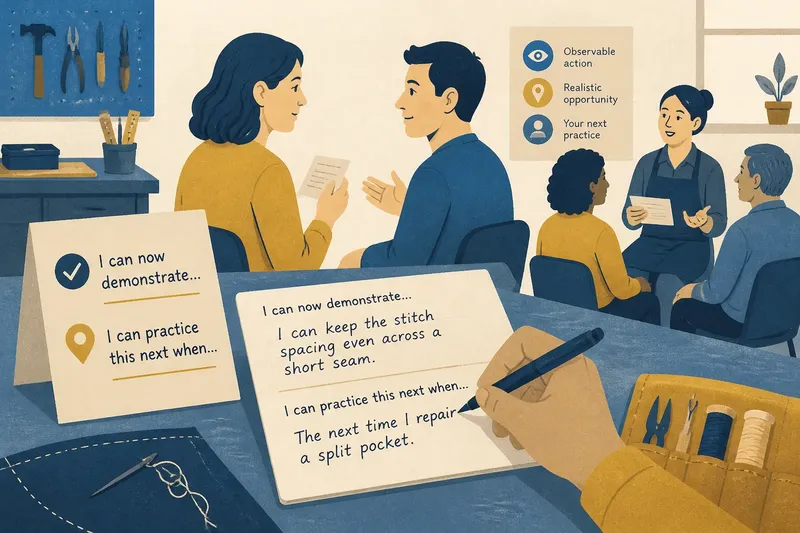
As chairs scrape back and someone caps a marker, a short workshop review can give the last few minutes a useful job. Ask each learner to name one skill they can now demonstrate and one next opportunity to practice it. The point is not to recap the whole session; it is to make a specific piece of learning easier to carry out of the room.
What should the review produce?
A useful closing reflection leaves each learner with two statements: a visible action they can perform, and a plausible setting in which to practice it again. “I understand sharpening” is hard to act on. “I can hold the whetstone steady and draw the blade across it at a consistent angle” names something another person could observe.
The next opportunity should be concrete enough to recognize, not so ambitious that it becomes a promise made under the influence of a closing bell. It might be the next time the learner prepares a tool, helps a colleague, or sets up the practice materials. The learner chooses the opportunity; the instructor helps make the skill description observable.
Which closing format fits your group?
There are three practical options: a private written note, a spoken pair exchange, or a brief round with the whole group. Each can produce the same two-part reflection, but each handles time, privacy, and instructor attention differently.
When does a private written note work best?
Give learners a small card or a blank section of their workbook and ask them to complete two prompts: “I can now demonstrate…” and “I can practice this next when…”. This suits groups that need a quiet pause, learners who prefer to think before speaking, and sessions where a whole-group round would take too long.
Collecting the notes is optional. If you do collect them, say what you will use them for; otherwise, invite learners to keep the card where they will encounter it before their next practice opportunity. A folded card beside a tool kit is a modest reminder, not a motivational campaign.
When should learners discuss their answers in pairs?
A pair exchange suits a group that benefits from saying the skill aloud and hearing a listener ask, “What would I see you do?” Allow each person a turn, with the listener helping replace broad labels with actions rather than rating the speaker’s ability.
This format gives learners a small rehearsal in describing their work. It is less suitable when the topic involves personal disclosures or when partners cannot hear one another comfortably. In those cases, a private note is simpler and kinder.
When is a whole-group round worth the time?
A short round suits a small group that needs to hear the different ways a skill can be practiced in real settings. Invite each person to offer one demonstrable action and one next opportunity, with passing allowed if someone would rather write privately.
The instructor can listen for a shared obstacle, such as missing materials or uncertainty about where practice can happen, and address it before people leave. Keep the round focused on the learner’s next action; turning it into a public assessment changes the exercise and can make answers less candid.
How do you choose among the three?
Choose by the kind of attention the group needs, not by which format looks most polished. A quick decision can follow these questions:
- Is privacy useful? Offer a written note, especially if learners may be unsure about their progress.
- Would saying the skill aloud sharpen it? Use pairs when learners can listen without needing to judge one another.
- Does the group need a shared view of next practice? Use a whole-group round if there is room for each person to speak without rushing.
- Is time especially tight? Use one written prompt for the skill and one for the next opportunity rather than squeezing in a hurried discussion.
- Will the instructor need to respond to a common barrier? Choose a format that makes that barrier visible, then leave a little time to address it.
Say you have a small workshop on hand stitching, and learners have practiced closing a seam. One learner writes, “I can keep the stitch spacing even across a short seam,” then chooses the next time they repair a split pocket as the practice opportunity. The result is a clear action and a recognizable cue to try it again, rather than a vague intention to become better at sewing.
How can you keep the reflection specific?
Use prompts that ask for evidence a person could see or hear. “What can you demonstrate now?” is more useful than “What did you learn?” The broader question can invite a long session recap, while the narrower one points toward an action.
If a learner offers a skill label such as “safe tool use” or “good alignment,” ask what the hands, materials, or finished work would show. Keep the question curious rather than corrective. The review is meant to clarify the learner’s next move, not to smuggle in a final critique after everyone has packed away.
For the next opportunity, ask for a cue rather than a calendar promise: “When will you next have the materials in front of you?” or “What task would give you a chance to try this?” A cue can be an ordinary event in the learner’s routine. If no plausible opportunity comes to mind, the instructor can help identify an appropriate practice setting before the session ends.
What questions come up when closing a workshop?
How long should a short workshop review take?
Long enough for learners to name both the demonstrable skill and a next practice opportunity, but not long enough to become a second lesson. Choose the written, pair, or group format according to the time and attention the session has left.
Should learners share their answers with the instructor?
Not necessarily. Private reflection can be useful on its own, while a shared answer lets the instructor notice unclear skill descriptions or practical barriers. Tell learners whether sharing is optional and how any collected notes will be used.
What if someone cannot name a skill they can demonstrate?
Invite the learner to name one part of the task that feels clearer, then identify what action would make that progress visible. If the skill is not ready to demonstrate independently, the next practice opportunity can include guidance rather than pretending the work is complete.
Can this review replace an assessment?
No. A short reflection records the learner’s own view of what they can do and where they might practice next; it does not establish competence. Use whatever assessment the learning goal requires, and keep this closing prompt focused on reflection.
How does the review help after people leave?
A short workshop review is most useful when the learner can recall it at the moment practice becomes possible. Encourage each person to keep the note with relevant materials, or to tell a partner the cue they chose. The format matters less than the pairing: one action that can be demonstrated, and one ordinary opportunity to attempt it again.
End by giving learners a quiet moment to write or think before the room empties. That small pause can turn the last conversation from a general verdict on the workshop into a workable intention for the next time their hands meet the task.